The Dingbat Was a Parking Rule With a Front Door
LA History / Jul 11, 2026 / 4 min read
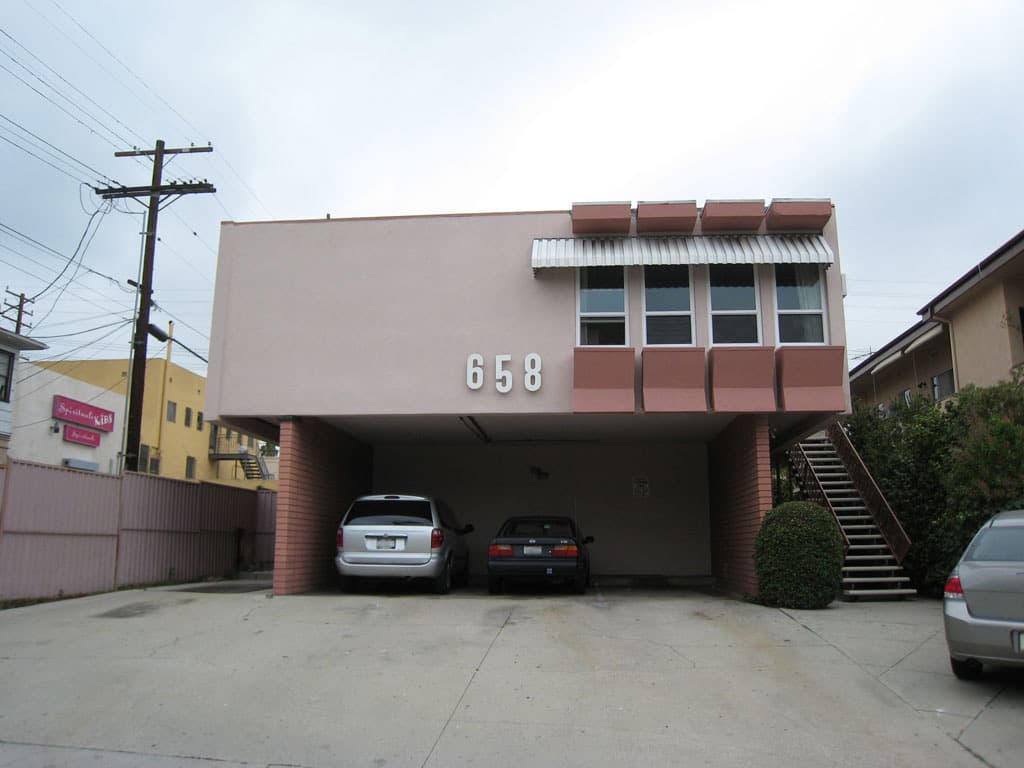
The dingbat is one of the few Los Angeles building types that seems to know people are laughing at it. It stands there anyway: stucco box, skinny balconies, a dramatic little name over the driveway, and cars tucked underneath like the building lifted its skirt to make room. Some are plain. Some are weirdly glamorous. Some look as if a developer spent all the ornament money in one fifteen-minute burst and then went home.
That is part of their charm, but the joke can get in the way. Dingbats are not random bad taste. They are a readable record of how postwar Los Angeles tried to squeeze more apartments onto small lots while keeping the car at the center of domestic life. The Los Angeles Conservancy describes the type as a two- or three-story stucco apartment building, often with parking at grade and units above. The city's Office of Historic Resources ties the form to housing demand, cheap construction, lot coverage, and parking requirements.
The equation was blunt. A single-family lot could produce more rent if it held several apartments. The developer wanted the building to cover as much of the parcel as possible. The city still expected parking. So the ground floor became a carport, and the apartments went on top. That decision solved one problem and created another. The open ground floor gave residents parking, but it also produced the soft-story condition that later made many dingbats vulnerable in earthquakes.
The front facade then had to make this bargain feel less bare. Many dingbats are practical boxes with a party hat. A screen, a starburst, a breeze-block panel, a fake Polynesian flourish, a little script lettering, or a name like Ding Dong could turn a cheap apartment block into a tiny fantasy address. The ornament was shallow, but it was not meaningless. It gave renters a place with a face.
That face mattered because the buildings were selling a small dream at a small scale. The promise was not a courtyard, a lobby, or a grand address. It was a clean unit, a parking spot, and the feeling that the building had enough personality to remember when you gave someone directions. In a city full of repeated stucco, a name on the front could do more work than it should have been asked to do.
Hayworth Avenue's dingbats show why preservationists care about buildings that many people learned to ignore. The Conservancy dates that cluster to the 1950s and 1960s and points to its rarity as a surviving concentration. Walking past a row of them, the repetition becomes more interesting than any single facade. You can see developers trying variations on the same problem: how to make a compact, car-serving apartment building look neighborly enough to sell.
There is a sly social history in that. The dingbat gave Los Angeles density without asking the city to admit that it was becoming dense. It kept the car right under the bedroom. It let small apartment buildings slide into neighborhoods that still wanted the mood of low-rise domestic life. It used decoration as a kind of handshake with the street. Yes, this is a box of units. Yes, it has parking tucked under it. Yes, it still wants to be a little glamorous.
The type's weaknesses are real. The parking voids created seismic problems. The buildings were often cheap. Some facades are more desperate than delightful. Redevelopment pressure has made ordinary examples easy to lose because few people want to fight for a building that already sounds like an insult.
That is why events like Santa Monica Conservancy's Dingbat 2.0 matter. They reframe the type before it disappears into nostalgia or demolition math. Once a building is understood only as ugly old stock, its replacement starts to feel inevitable. Once it is understood as a clue, the conversation changes.
Still, the dingbat deserves better than a shrug. It explains a piece of Los Angeles more clearly than many better-behaved buildings do. In one small form, it shows the city's postwar appetite for apartments, its loyalty to the car, its fear of looking too urban, and its strange need to paste a little fantasy over the practical facts.
Further Reading
View the sources for this article
- Los Angeles
- dingbat apartments
- housing history
- parking