The Office Building That Had to Prove It
General / Jul 15, 2026 / 3 min read
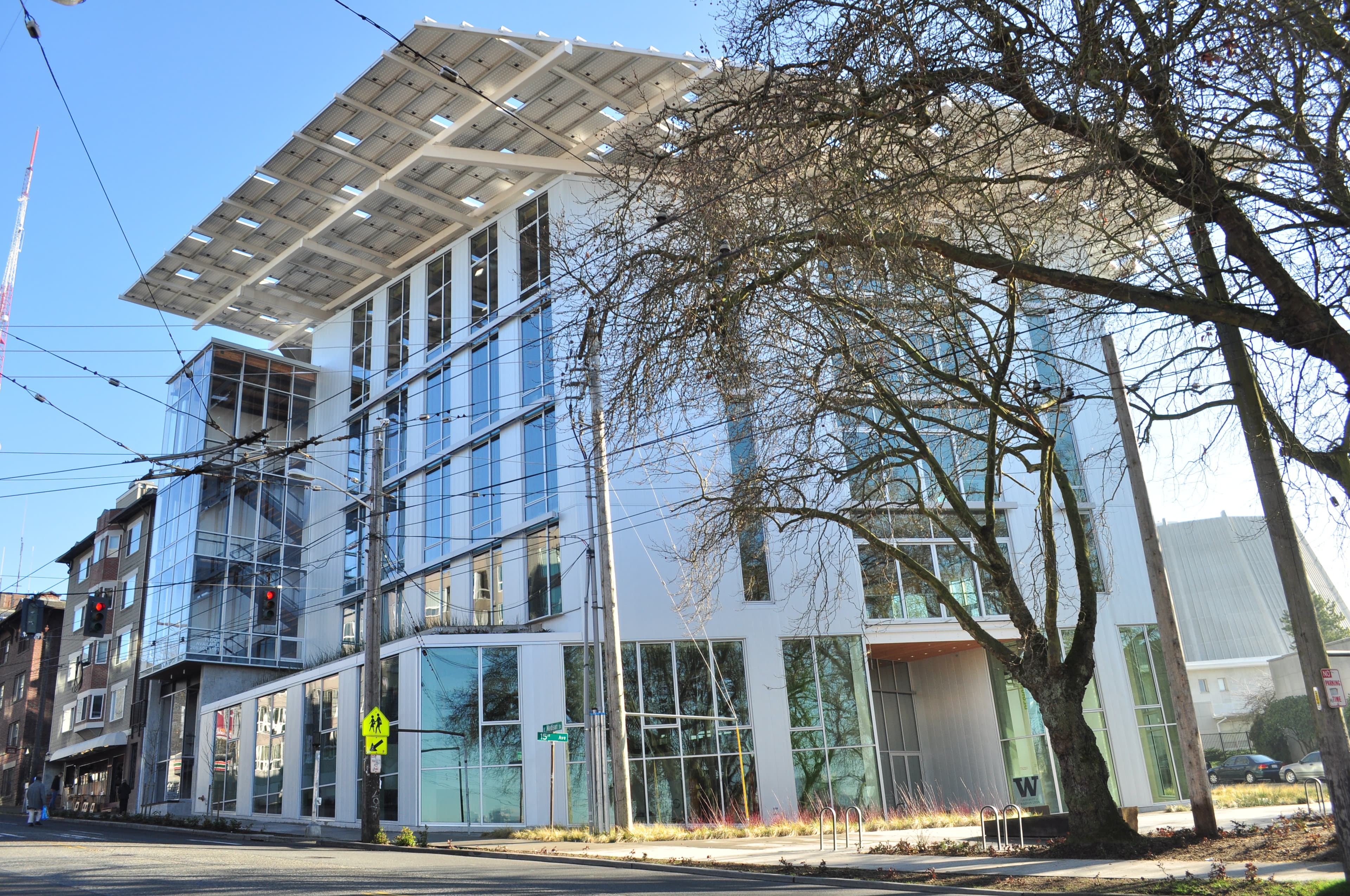
The Bullitt Center's most interesting feature is not the roof, though the roof does most of the posing. It stretches beyond the six-story office building like a flat solar hat, wide enough to make the whole project instantly recognizable. In Seattle, where winter light is not exactly generous, that canopy is also a dare. The building claimed it could make more energy than it used.
The useful part is what happened after opening day. Many green buildings are sold on predictions: modeled energy use, certification points, diagrams of airflow, materials lists, and renderings where every terrace looks freshly watered. The Bullitt Center had to deal with a less flattering test. Under the Living Building Challenge, a project has to operate before it can fully prove itself. The University of Washington case study describes the standard as performance-based across categories such as energy, water, materials, site, health, equity, and beauty. The building could not simply say what it intended to do. It had to spend a year doing it.
That changes how the design reads. The photovoltaic canopy is not decoration for an environmental story. It is the power source the energy budget depends on. The stair is pulled to the front, bright and visible, because the building wants people to use it instead of automatically taking the elevator. Rainwater capture, composting toilets, operable windows, daylighting, FSC-certified wood, and screened materials are often described as a list of sustainable features. In this building they are closer to conditions of a bargain: if one piece performs badly, the claim weakens.
The Bullitt Foundation announced full Living Building Challenge Petal Certification in 2015 and said the building had produced more electricity from its roof than occupants used over the course of a year. That matters because the sentence points backward. It is not a promise about what the building should do in theory. It is a report on what happened when tenants moved in, lights turned on, toilets flushed, windows opened, and the weather did whatever Seattle weather felt like doing.
There is something refreshingly impolite about that standard. It refuses to let architecture stay in the flattering world of intent. A building may be beautifully detailed, sincerely designed, and packed with expensive systems, then still miss the mark once people start using it. Performance does not care whether the rendering was noble.
The Bullitt Center also shows why proof is hard to generalize. Its owner had an unusually strong mission. Its tenants entered a building that asked them to participate. Seattle's climate, the educational purpose, the financing, and the willingness to accept unfamiliar systems all mattered. A speculative office tower built only to maximize rent would face a different set of pressures. That does not make the project irrelevant. It makes the lesson more precise.
The building's real contribution is not a style to copy. It is a standard of honesty. If a building makes a public environmental claim, it should eventually be willing to show the receipts. The Bullitt Center is memorable because its most dramatic gesture, that big solar roof, is tied to a measurable obligation. The handsome part and the strict part are the same thing.
Further Reading
View the sources for this article
- Seattle
- Living Building Challenge
- office buildings
- performance