The Wildlife Crossing Is a Bridge for a Broken Map
LA Current / Jul 4, 2026 / 4 min read
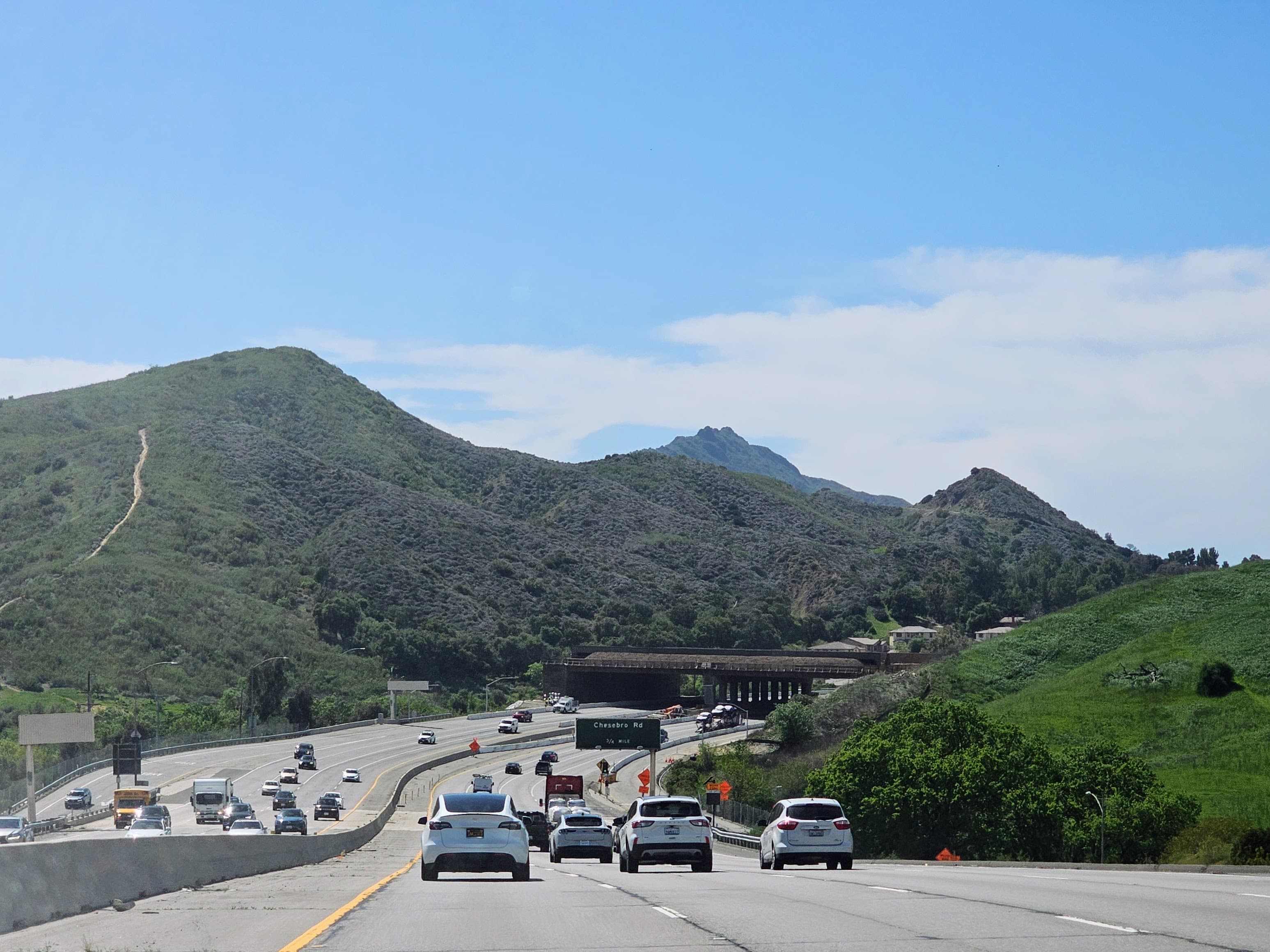
The Wallis Annenberg Wildlife Crossing is easy to make cute, which is probably the least useful way to understand it. Yes, the future users include mountain lions, bobcats, coyotes, mule deer, and smaller animals. Yes, there is something satisfying about giving wildlife a bridge over a freeway built for cars. But the project at Liberty Canyon is not a sweet gesture. It is a repair job for damage that became normal because humans got used to driving through it.
The problem sits in the geography. At Agoura Hills, the 101 cuts across a place where protected open spaces in the Santa Monica Mountains should connect with habitat to the north. A driver experiences the freeway as a route through the landscape. An animal experiences it as noise, light, pavement, fencing, and death moving at highway speed. The National Park Service's mountain lion research has long pointed to isolation in the Santa Monica Mountains, where roads and development limit movement and genetic exchange.
Caltrans describes the crossing as a vegetated bridge west of Liberty Canyon Road. That sounds simple until the pieces come into view. The structure has to carry soil and planting, connect to real habitat on both sides, guide animals toward the safe route with fencing, restore hydrology, protect heritage oaks, and extend over Agoura Road as well as the 101. The final phase, announced by Caltrans in June 2025, includes earthwork, utility relocation, habitat work, and the extension over Agoura Road. Completion is expected in fall 2026.
The project also has to work for animals that will never read a sign. A crossing like this succeeds only if the approach feels continuous enough that wildlife accepts it as terrain. That means the boring pieces, especially fencing and planting, are not secondary. They are how the bridge teaches movement without teaching anything at all.
The scale is what makes the project feel strange. A wildlife crossing does not fit neatly into the way people usually talk about transportation spending. Caltrans lists a programmed cost of about $92 million. The governor's office described a public-private partnership and an additional funding push in February 2026, after decades of conservation work in the area. For anyone used to infrastructure being justified by commuters, freight, or lane capacity, that number can seem hard to process.
That discomfort is part of the story. Freeways are allowed to be expensive because people have learned to count their benefits. Habitat fragmentation is expensive too, but the costs are easier to ignore. They show up as isolated animals, roadkill, weakened genetics, and mountain ranges that no longer function as connected living systems. Those costs only become visible after scientists, agencies, advocates, and donors spend years translating ecological damage into a project that a transportation department can build.
The design tries to make the bridge disappear for the animals that need it. Native coastal sage scrub and other planting are meant to turn the structure into a strip of familiar terrain. The crossing is wide enough to feel less like a narrow chute and more like a continuation of the hillside. Fencing does the unglamorous work of steering movement toward the bridge instead of letting animals gamble at the road.
For Los Angeles, the project is a rare admission. The freeway changed what nature could do. It made some movements impossible and others deadly. The crossing cannot undo the 101, and it will not make the Santa Monica Mountains wild in some untouched sense. The landscape is already tangled with cities, roads, houses, trails, and utility corridors.
Still, Liberty Canyon changes the hierarchy for one small piece of that tangle. The freeway remains, but it is no longer treated as the only system that matters. For once, the road has to make room for the mountain range it interrupted.
Further Reading
View the sources for this article
- Los Angeles
- wildlife crossing
- Santa Monica Mountains
- infrastructure