What a Courtyard Apartment Was Supposed to Do
LA History / Jul 25, 2026 / 4 min read
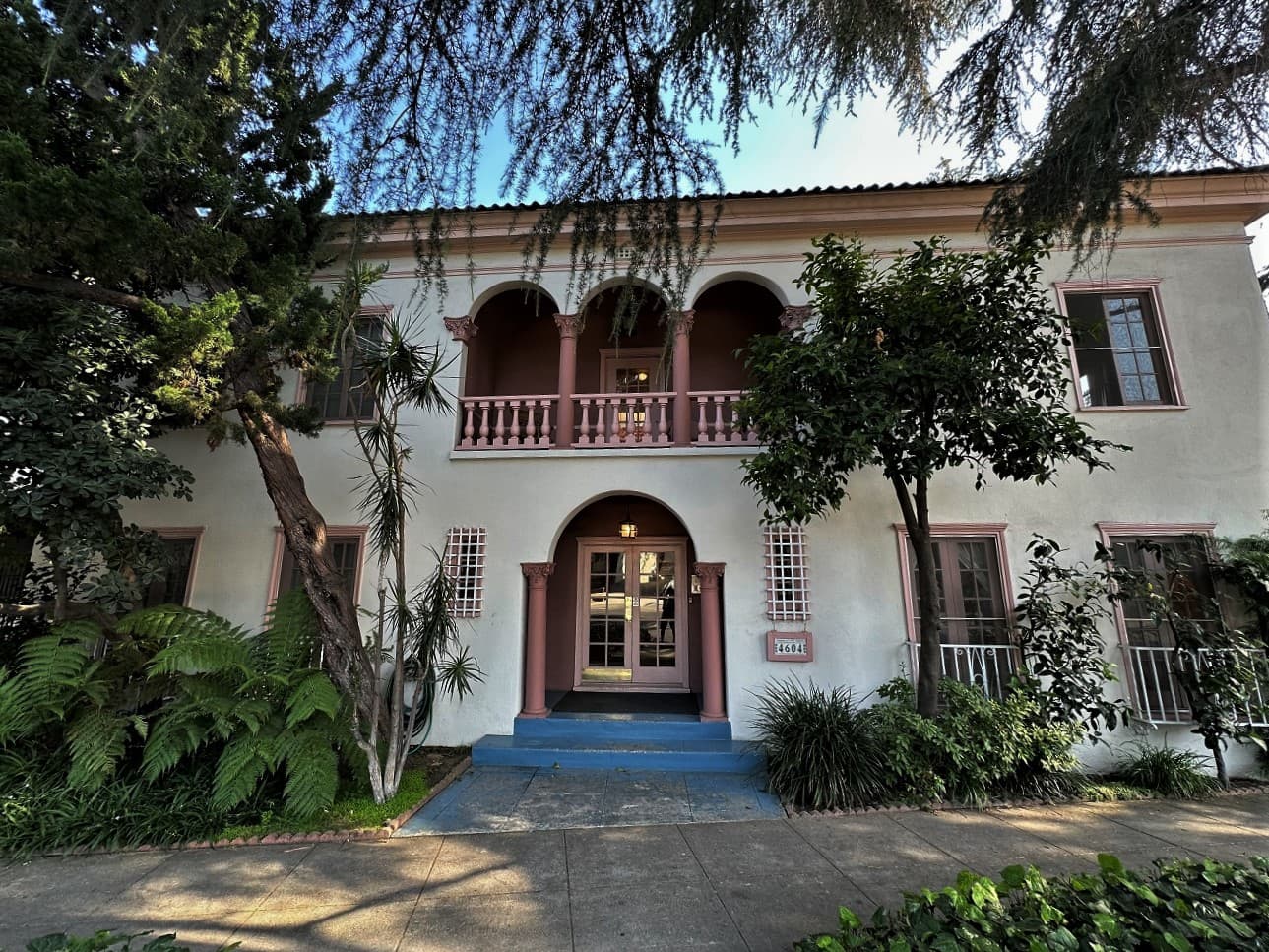
The first trick of a courtyard apartment is that it delays the front door. You leave the sidewalk, pass through an opening, and suddenly the building has pulled you into its own little weather system. There may be a fountain, tile steps, iron rails, a palm, a strip of lawn, a bit of shade. The apartment itself is still private, but getting there has become a small outdoor event.
That experience mattered in Los Angeles because the city was trying to grow without giving up its favorite fantasy of domestic life. In the 1910s and 1920s, population growth pushed builders toward denser housing. The detached house could not carry the whole city. Bungalow courts had already offered one answer: small units arranged around a shared outdoor space. Courtyard apartments took that idea upward. They stacked more homes on the land while trying to keep the garden as the emotional center of the building.
The National Register draft for the Los Feliz Boulevard Courtyard Apartments Historic District describes the type as a successor to bungalow courts and notes that courtyard apartments began appearing in Los Angeles in the 1910s before reaching a peak in the 1920s. The form was not copied from one single tradition. The nomination points to Mediterranean, Mexican, European, Middle Eastern, and California adobe precedents. That mixture makes sense for Los Angeles, a city very good at borrowing old atmospheres for new real-estate problems.
The practical move was simple. Instead of sending residents down an interior corridor, the building wrapped units around a shared open court. U-shaped plans were common. Windows and doors could face inward, toward the garden, instead of giving the street all the attention. The court brought in light and air, but it also staged daily life. People crossed the same paving, passed the same planting, heard the same water, and still disappeared into their own apartments.
That is the part worth taking seriously. The courtyard solved several problems at once. It gave a denser apartment building a sense of arrival. It made circulation feel social without making it fully public. It let developers sell a more urban building with the language of gardens, romance, and privacy. The resident lacked a detached-house front yard. The walk home still had a threshold, a pause, a little ceremony.
Los Feliz Boulevard is a useful place to see the type because the surviving district shows the idea at neighborhood scale. The National Register draft describes a concentration of courtyard apartments along the boulevard, shaped by 1920s development, revival styles, street widening, and the planted character of the corridor. The buildings are not identical, which is part of the pleasure. Some are lush and theatrical. Some are calmer. Together they show how many ways Los Angeles builders could repeat the same basic promise: more homes, still wrapped around a piece of outdoor life.
The boulevard setting also matters. These were not hidden compounds in the hills. They sat along a visible city street, with deodar cedars, widened pavement, traffic, and apartment entrances all sharing the same frame. The court gave each building a way to turn inward without fully withdrawing from the street.
The promise weakened as the century changed. Depression-era conditions, wartime limits, postwar parking expectations, cheaper construction, and changing taste pushed apartment design toward other forms. Later complexes often kept outdoor space, but the feeling changed. Pools, parking courts, and larger garden apartments did different social work than the intimate revival-style courtyards of the 1920s.
The older courtyard buildings can seem merely pretty now, which sells them short. Their real interest is the compromise they attempted. Los Angeles wanted density, privacy, climate comfort, garden imagery, and a feeling of arrival. The courtyard apartment tried to put all of that into one walk from the street to the door. At its best, the type made multifamily housing feel less like a concession and more like a small shared world.
Further Reading
View the sources for this article
- Los Angeles
- courtyard apartments
- housing history
- Los Feliz